
Estallidos 8
ESTALLIDOS 8 is an ongoing research project (Oct. 2023 -- Oct. 2027) funded by the Agencia Estatal de Investigacion of the Spanish Ministry of Science and Innovation (PID2022-136598NB-C3*). It will provide fundamental knowledge on the multiple faces of star formation (SF), one of the key processes driving cosmic evolution. SF is inherently complex, requiring progress through many incremental but significant steps. Our project focuses on carefully chosen aspects of SF that are both timely and aligned with recent advances in the field.
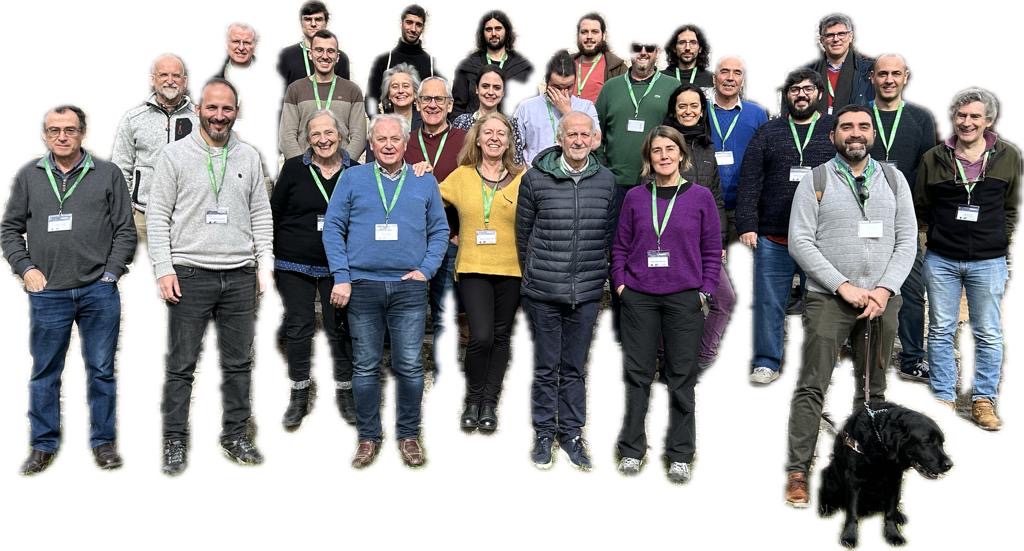
The ESTALLIDOS collaboration formally began in 2001, building on earlier efforts of the Grupo de Estudios de Formación Estelar (GEFE). Over more than two decades, we have become a consolidated international team and a recognized reference in SF research. Our distinctive approach combines observational and theoretical expertise, spanning multi-wavelength data analysis, advanced statistical and numerical techniques, and detailed studies of nearby galaxies to understand the starbursts that shaped the early Universe.
Our track record includes over 1,000 publications in leading journals , more than 30 PhD theses, and the organization of 15+ scientific meetings. Former students are now established researchers in institutions across Europe, the Americas, and Australia.
Building on this foundation, ESTALLIDOS 8 will extend our knowledge from the local Universe to the early epochs of galaxy formation, leveraging the unprecedented datasets from JWST and next-generation integral field units (IFUs). We will refine and apply our methodologies to high-redshift observations, reducing systematic errors that currently hinder interpretation. In addition, the project will pioneer the use of artificial intelligence for data analysis and contribute to the development of new instrumentation, ensuring long-term impact on astrophysics.
Estallidos 8 addresses the study of the following general objectives,
- I. The study of structures within spiral galaxies
- II. Multi-wavelength characterization of star formation
- III. Key aspects of star formation in a cosmological context
- IV. Understanding reionization-era galaxies and their local analogues: massive star formation from the earliest galaxies to the cosmic noon
- V. Star formation, metallicity, and galaxy evolution in extreme environments
- VI. Construction of advanced instrumentation for large telescopes: TARSIS and MOSAIC
There are three nodes: (1) Canarias, leading objective III, (2) Granada, leading objectives IV, V, and VI, and (3) Madrid, leading objectives I and II. The long list of participants and collaborators is given in here. Further details are given in the approved proposal, which is in this document.