


14/10/2025: Dr. Junais - Hidden structures and a turbulent past in one of the largest spiral galaxies in the Universe
As part of the ExGal-Twin programme, astronomers at the Instituto de Astrofísica de Canarias (IAC) including ExGal-Twin postdoctoral researcher Dr. Junais, used the 2-metre robotic Two-meter Twin Telescope (TTT) at the Teide Observatory to obtain the deepest optical images to date of Malin 2, one of the largest known spiral galaxies in the Universe. These ultra-deep observations reveal previously unseen, extremely faint structures in and around the galaxy, including diffuse stellar emission and a striking, elongated spiral-like feature that hints at past interactions. The team also discovered a candidate ultra-diffuse satellite dwarf galaxy about 400,000 light-years from Malin 2, potentially its first known dwarf companion. The findings of this work suggest that tidal interactions may play a much bigger role in shaping the formation of the largest spiral galaxies in the universe than previously thought.
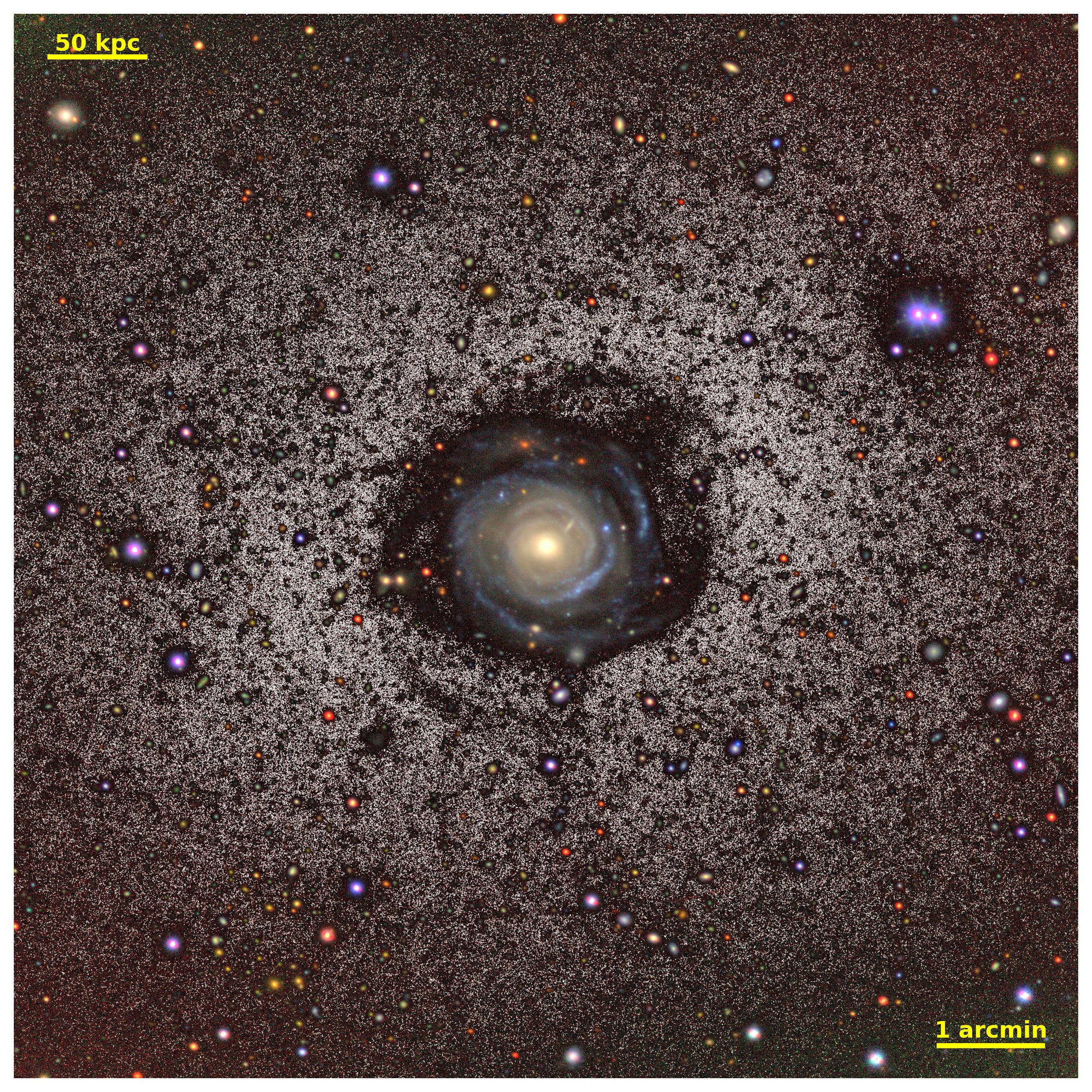
Caption: Deep optical image of the giant low surface brightness galaxy Malin 2, obtained with the Two-meter Twin Telescope (TTT) at the Teide Observatory. The image reveals previously unseen faint stellar structures and diffuse features around the galaxy. Credit: Junais et al. 2025 / TTT.
15/04/2026: Dr. Audibert scientific highlights
Dr. Anelise Audibert is carrying out a pilot study within the WEAVE-Apertif survey to investigate AGN properties across the optical, HI, and radio regimes. Using 53 WA galaxies observed so far with WEAVE, including three AGN identified from Verón-Cetty & Véron catalog, the project compares ionized-gas kinematics with neutral HI and derives radio-based star formation rates to contrast them with HI- and optical-based estimates, providing a radio continuum characterization of the WA sample.
In another project, Dr. Audibert was awarded high-resolution VLA observations (PI Audibert) in collaboration with RUG for a sample of nearby obscured quasars. These data reveal compact jets and extended low-surface-brightness radio structures, highlighting the importance of radio-mode feedback in actively accreting systems.
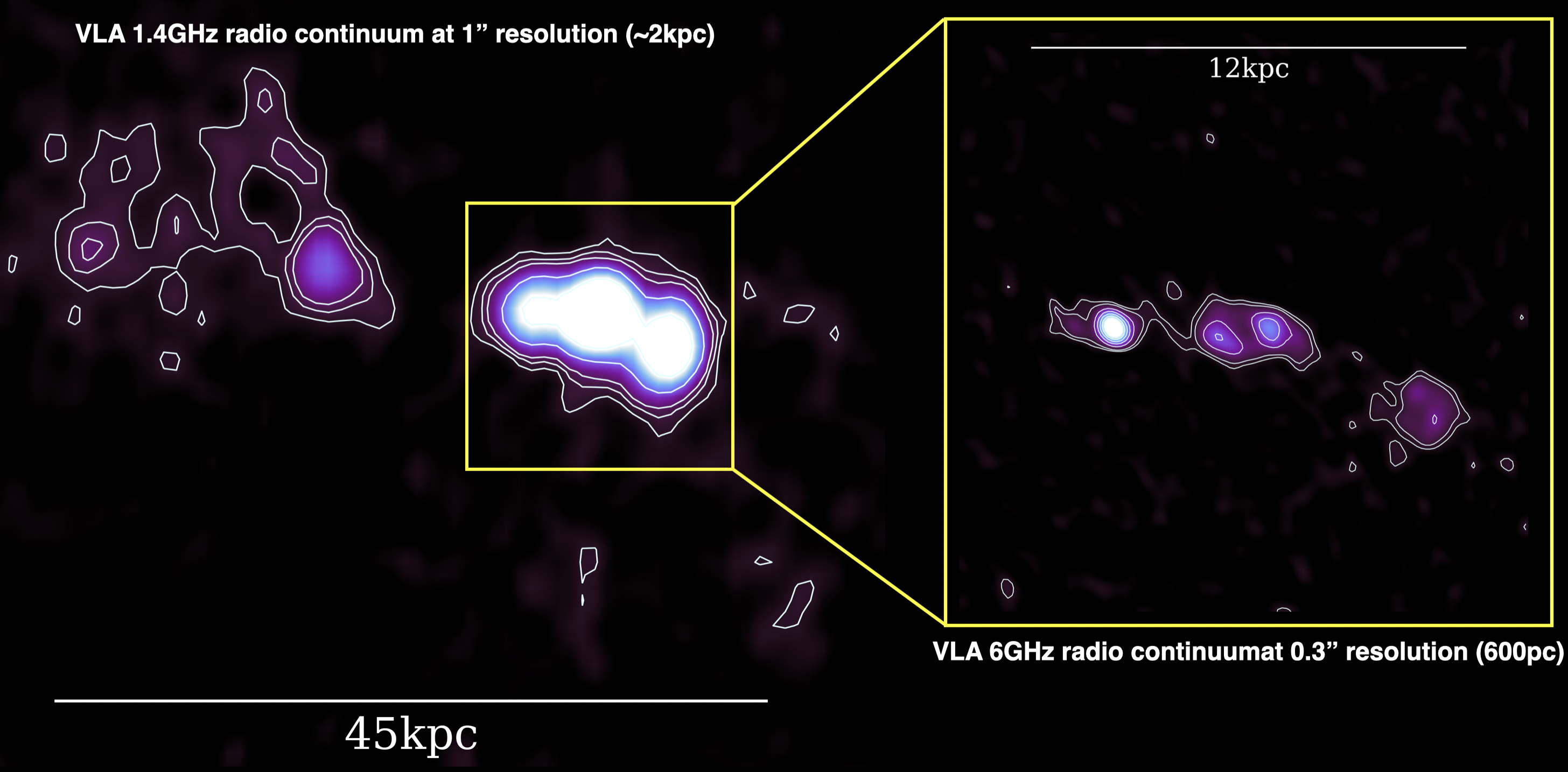
Caption: Example of diffuse radio emission at 1.4GHz (left) in J0841+01 extending up to 45 kpc and a zoom out to high-resolution observations at 6GHz, revealing a small scale (~12kpc) radio jet, part of Anelise’s VLA pilot sample of obscured quasars (PI Audibert, ID 24B-307).
04/09/2026: Dr. Durán Camacho scientific highlights
Bars are elongated stellar structures that reshape the discs of galaxies like our own, funnelling gas inwards and lifting stars out of the plane into a "boxy/peanut" bulge. Within ExGal-Twin's numerical modelling programme, Dr. Eva Durán Camacho evolved fifteen hydrodynamical simulations of Milky Way-like galaxies with the AREPO code, varying their initial stellar mass and bulge content. The suite shows that these starting properties set when a bar and its boxy/peanut bulge appear (massive, disc-dominated galaxies build them first) but have far less influence on the bars' final state, which converges across the whole suite.
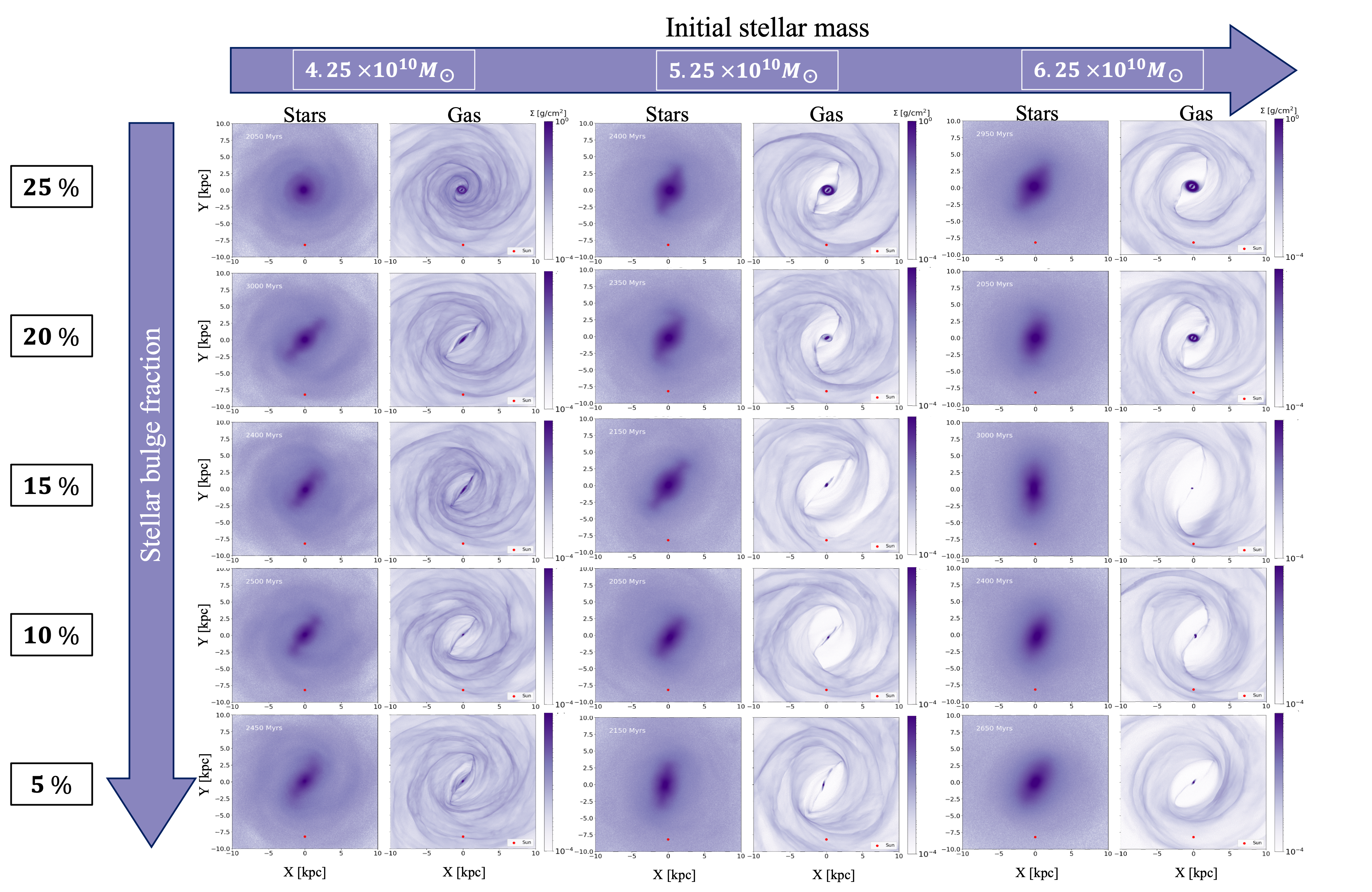
Caption: Face-on view of the fifteen simulated Milky Way-like galaxies, showing the stellar and gas surface density of each model at 3 Gyr. Initial stellar mass increases from left to right (4.25, 5.25 and 6.25 x 10^10 solar masses) and the fraction of stellar mass in the central bulge decreases from top to bottom (25% to 5%). Every model develops a bar and a pair of gas lanes channelling material towards the centre; the red dot marks the position of the Sun in the Milky Way for scale. Credit: Durán-Camacho et al. 2025