
Workshop I: Madrid Jaunary 27-28, 2003
STAR FORMING DWARF GALAXIES
|
CSIC (Madrid) The key aim of this project, "Estallidos de Formación Estelar en Galaxias", is the study, both theoretically and observationally, of starbursts and their impact on the galaxies hosting them. Our aim is to define the extent of these bursts as well as the key parameters that allow their feeding, leading to the birth of future generation of stars. To this end a carefully selected sample of starburst galaxies has been chosen covering a wide range of properties, from nearby spiral galaxies hosting nuclear starbursts, through those in dwarf galaxies, Giant HII regions in spiral and irregular galaxies, and including galaxies hosting active nuclei. We differentiate between isolated objects that behave as closed ecosystems from those, in denser environments, galaxy clusters or groups . The later should have their star formation rates and evolution conditioned by the environment. The proposal of the Coordinated Project is structured in programmes, each one containing a well-defined sample of objects. We have also defined a master galaxy sample containing archetypical objects from each subsection that will be studied by the whole group, in the entire wavelength range. We will carry out X-Ray, UV, visible, IR and radio observations, with both ground-based and space telescopes. This will allow a determination of the star formation rate (SFR) with several independent methods. This is one of the main objectives of this project, in which we join the varied expertise of the team, for reaching a consistent value of the SFR. Notice that the SFR is a key parameter that influences heavily the models of formation and evolution of the Universe. The SFR will be correlated with parameters describing the structure of the galaxy hosting the starbursts. Measuring the SFR with several different methods in nearby objects will set a solid basis for the application of these techniques to objects at cosmological distances, after a careful evaluation of the problems (extinction, Lyman a absorption, aperture effects, etc.) affecting its determination. We believe that these objectives are reachable within the framework presented. In particular, the much needed calibration of the SFR of the Universe is a milestone for the progress on this field. Our team includes the necessary expertise and therefore is fully prepared to reach the goals herein stated. |
|
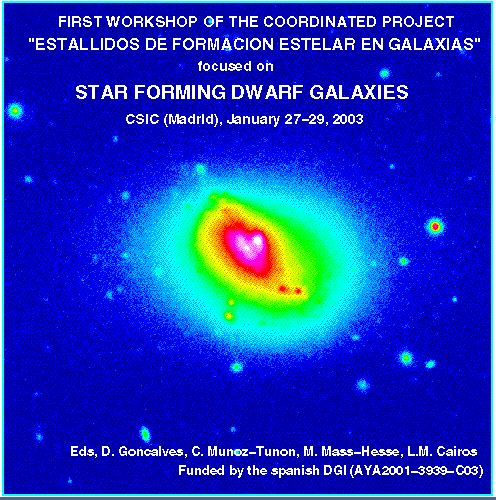
Organización
The workshop is organized by our cordinated group, which joints the Instituto de Astrofísica de Canarias (IAC), the Instituto de Astrofísica de Andalucía (IAA) and the Laboratorio de Astrofísica Espacial y Física Fundamental (LAEFF).
Scientific Organizing Committee
- Luz Marina Cairós
- Miguel Cerviño
- Denise R. Gonçalves
- Jorge Iglesias Páramo
- Miguel Mas Hesse
- Casiana Muñoz-Tunón
- Jose M. Vílchez Medina.
Local Organizing Committee
- Miguel Mas Hesse
- Concha Prieto