
NEWS & PRESS RELEASES
You can see a summary of the news here, but to see our latest news, go to Presentation and scroll down through that section.
-
15 March 2024
AstrotalkUK Episode 112 – Brown Dwarfs, Dark Matter and Dark Energy
Prof. Eduardo Martín, SUBSTELLAR Principal Investigator, was interviewed for AstrotalkUK.
The Episode 112 was recorded in Tenerife by Gurbir Singh, who established in 2008 Astrotalkuk.org, a not for profit Website / Blog on Astronomy, Space and his writing.
Professor Martín is one of the two Euclid mission Independent Legacy Scientists. He is a specialist in substellar bodies, that is celestial bodies with a size about that of Jupiter but with around 50 times its mass.
More details at AstrotalkUK Episode 112
2023
-
14 December 2023
Three Postdoctoral Contracts SUBSTELLAR
The Instituto de Astrofísica de Canarias (Tenerife, Canary Islands) invites applications for three postdoctoral contracts to work on the project linked to the line of research “Substellar Science with EUCLID”.
These contracts are funded by the project “Substellar Science with the Euclid Space Mission (Horizon Europe-ERC-2021-ADG, Gran Agreement 101054354), within the framework of the ERC Advanced 2021 Grant call of the European Research Council Executive Agency within the Horizon Europe financing program of the European Commission, and led by Prof. Eduardo L. Martín.
The appointed candidates will benefit from the research environment at the IAC, which hosts one of the pioneering groups in substellar science around the world. The group is involved in several instrumentation programs, telescope developments, and large area surveys, particularly those carried out with the Euclid space mission.
Application deadline: January 31st 2024
More details at SUBSTELLAR postdoctoral contracts
-
7 July 2023
Euclid release its first images: the dazzling edge of darkness
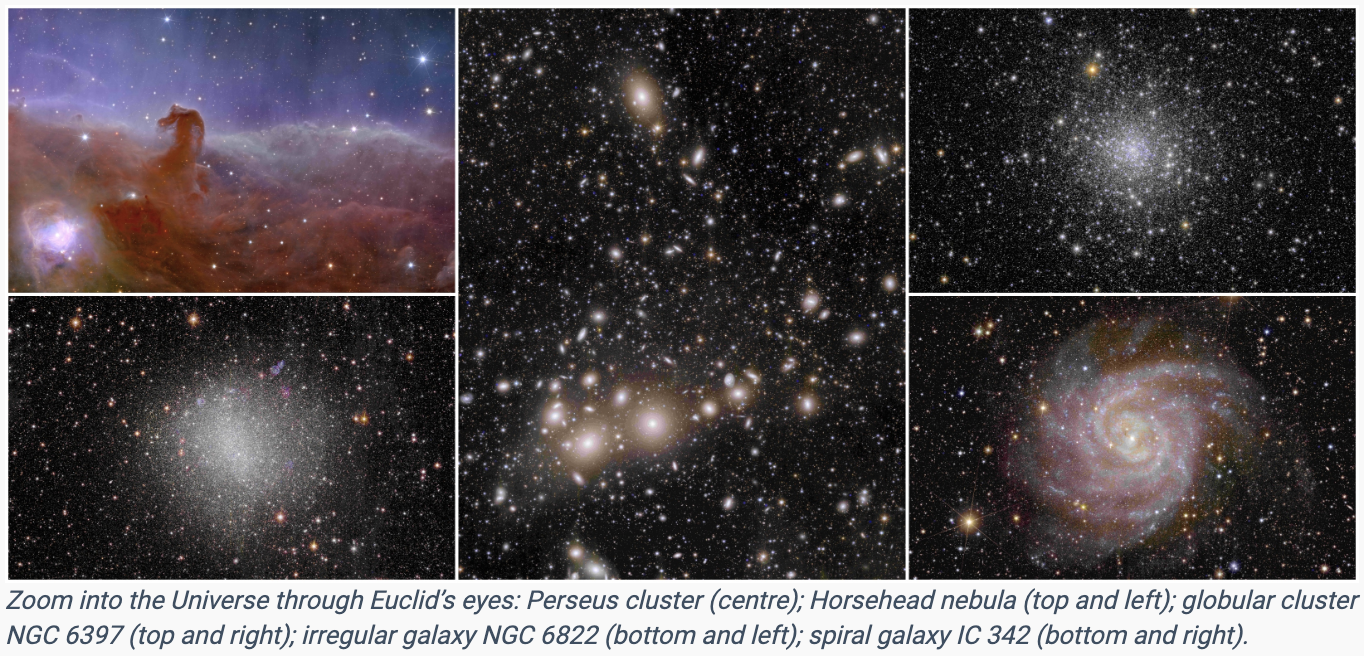
ESA’s Euclid space mission reveals its first full-colour images of the cosmos. Never before has a telescope been able to create such razor-sharp astronomical images across such a large patch of the sky, and looking so far into the distant Universe. These images illustrate the telescope's potential to create the largest and most accurate 3D map of the Universe to date. The Instituto de Astrofísica de Canarias (IAC) has led one of the first five Euclid Early Release Objects (ERO) programmes.
“In the first images of Euclid we are already obtaining that expectations are exceeded, allowing us to go beyond what was expected in the limits of detection. We are sure that, in the coming years, Euclid will help us discover an unprecedented number of dark ultracold objects of substellar mass, facilitating a great advance in the investigation of their curious properties and it is even possible that we can reveal their mysterious origin,” says Eduardo Martín Guerrero de Escalante, IAC research professor, principal investigator of one of the first five Euclid images announced by ESA (the one that includes the Horse Nebula in Orion) and one of the two Euclid mission Independent Legacy Scientists.
More details at: IAC Euclid first images press release
More detailed information about Euclid images at ESA Press Release
-
1 July 2023
Euclid: Journey to darkness
Video prepaded and published by the European Space Agency
ESA’s Euclid mission was launched into space on a SpaceX Falcon 9 from Cape Canaveral in Florida, USA, on 1 July 2023. It is now on its way to Sun-Earth Lagrange point L2.
By observing billions of galaxies out to 10 billion light-years, the space telescope will create the most detailed 3D-map of the Universe, with time as the third dimension.
The launch broadcast programme includes live segments from the launch site and ESA’s European Spacecraft Operations Centre (ESOC) in Darmstadt, Germany.
See the video on You Tube: Euclid: Journey to the darkness
Credits: ESA - European Space Agency / SpaceX
-
19 June 2023
Euclid: ESA’s mission into the unknown
Video prepaded and published by the European Space Agency
ESA’s Euclid mission is designed to bring the dark side of the Universe to light. Based on the way galaxies rotate and orbit one another, and the way in which the Universe is expanding, astronomers believe that two unseen entities dominate the composition of our cosmos. They call these mysterious components dark matter and dark energy, yet to date we have not been able to detect either of them directly, only inferring their presence from the effects they have on the Universe at large. To better understand what dark matter and dark energy may be, we need a mission that can more closely reveal what effects they have had on galaxies, galaxy clusters and the expansion of the Universe itself. Euclid is that mission.
See the video on You Tube: Euclid: ESA’s mission into the unknown
Credit: ESA - European Space Agency
-
30 June 2023
The Euclid telescope takes off to explore the dark universe
Published on IAC Website, June 30th 2023
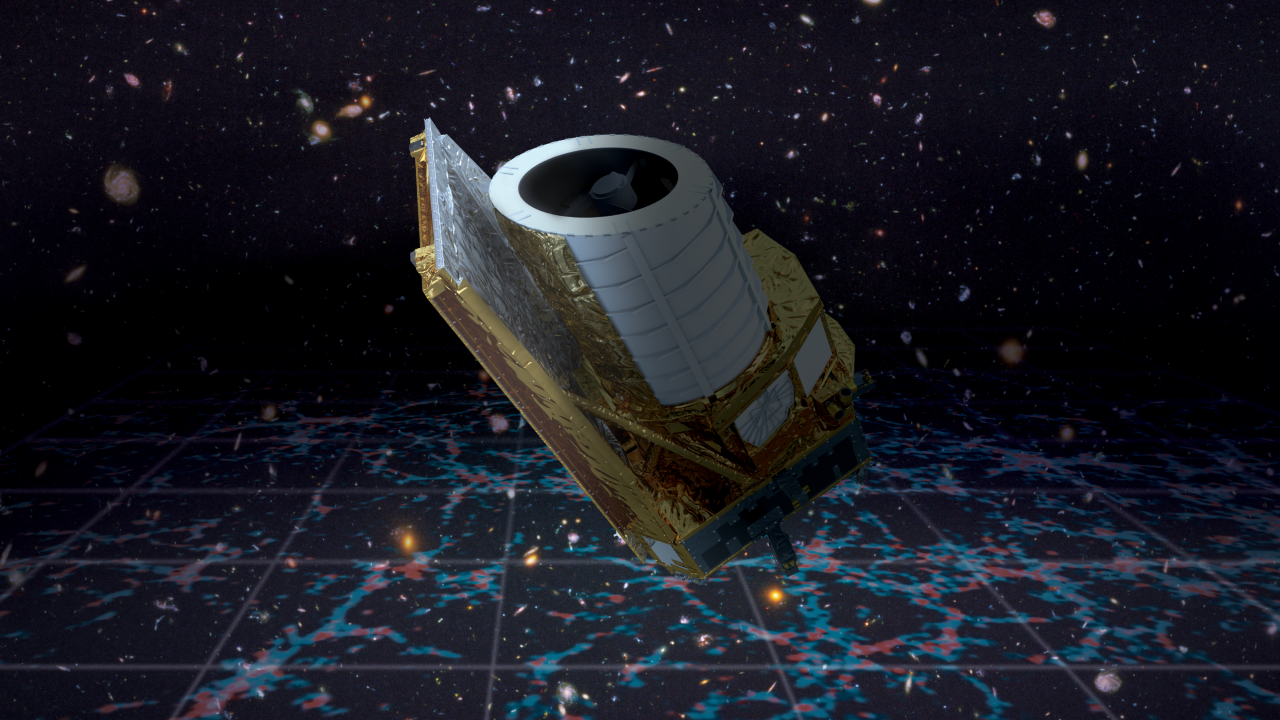 The Euclid mission of the European Space Agency (ESA) will be launched into space tomorrow, 1st July to make the largest and most precise 3D map of the Universe. Spain has an important role in this project, where it is part of the the Consortium which has driven the mission since its origin.
Spain has also participated significantly in the instrument design of the project, and will contribute to its scientific use. The Instituto de Astrofísica de Canarias (IAC) has collaborated in the design, construction and testing of the control electronics for one of the on-board instruments. It also leads several scientific programmes aimed at using the data from Euclid for cosmological research into the properties of dark matter, the study of the formation and evolution of the galaxies, and the identification of objects of sub-stellar mass.
The Euclid mission of the European Space Agency (ESA) will be launched into space on Saturday 1st July on a Falcon 9 rocket of SpaceX from the Kennedy Space Center, Cape Canaveral, Florida (USA). Several Spanish institutions, among them the IAC, have worked for 11 years on this mission, which will help us to understand dark energy and dark matter. According to current models these dark components form some 95% of the matter and energy content of the Universe, and affect the motions and the distribution of the visible sources, such as the galaxies, even though they neither emit nor absorb light. Because of this science has not been able to determine what they are. Understanding them presents two of the most important challenges in modern cosmology.
See the IAC press release at The Euclid telescope takes off to explore the dark universe
-
12 June 2023
Three pre-doctoral contracts within the framework of the "SUBSTELLAR ERC Advanced Grant Project"
The IAC (Tenerife, Spain) invites applications for three PhD fellowships in Astrophysics in the framework of the project “SUBSTELLAR ERC Advanced Grant”.
The research topics pursued at the IAC include most areas of Astrophysics: Solar Physics, Planetary Systems, Stellar and Interstellar Physics, Galaxy Formation and Evolution, Milky Way and Cosmology and Astroparticle Physics. These are supported by an ambitious instrumentation programme. The IAC has been selected as a “ Severo Ochoa Center of Excellence ” in research by the Spanish Government. Further information about the IAC's research programme, its Observatories and the 10.4 m telescope GTC is available on the IAC's Web site.
The successful candidates will work at the IAC's headquarters in La Laguna, (Tenerife) in a stimulating research environment. They will be expected to join one of the IAC's research groups and work towards obtaining a PhD.
Application deadline: July 17th 2023
More details at SUBSTELLAR three PhD contracts
-
5 May 2023
Euclid Launch Kit
The European Space Agency (ESA) realeased an interactive media kit to inform the public about scientific and technological themes of the Euclid mission through the series of infographics.
ESA's Euclid mission is designed to map the large-scale structure of the Universe and help us to understand two mysterious components: dark matter and dark energy.
Euclid will create the largest, most accurate 3D map of the Universe. It will observe billions of galaxies out to 10 billion light-years, across more than one third of the sky. With this map, Euclid will reveal how the Universe has expanded and how large-scale structure has evolved over cosmic history. And from this we can learn more about the role of gravity and the nature of dark energy and dark matter.
More info at Euclid Launch Kit
-
12 December 2022
ONE postdoctoral contract SUBSTELLAR
Published on IAC Website, December 12tth 2022
The IAC (Tenerife) invites applications for one postdoctoral contract to work on the project linked to the line of research “Stellar and interstellar physics: substellar objects and young ultracool dwarfs in Euclid”. The contract is funded by the project “Substellar Science with the Euclid Space Mission (SUBSTELLAR)” (HORIZON EUROPE-ERC-2021-ADG, Gran Agreement number: 101054354), within the framework of the ERC Advanced 2021 Grant call of the European Research Council Executive Agency within the Horizon Europe financing program of the European Commission, and led by Prof. Eduardo L. Martín.
Application deadline: January 31st 2023
More details at SUBSTELLAR one postdoctoral contract
-
27 October 2022
The European Research Council has awardeb one of its prestigious "ERC Advanced Grants" to IAC´s SUBSTELLAR Project leading by Prof. Eduardo Martín
Published on IAC Website, October 27th 2022
Th
 e European Research Council (ERC) has awarded an ERC Advanced Grant, funding for the development of research projects at the frontiers of knowledge, to the Professor of the Higher Council for Scientific Research (CSIC) Eduardo L. Martín Guerrero de Escalante, who is an active researcher at the Instituto de Astrofísica de Canarias (IAC).
The project, entitled “Substellar Science with the Euclid Space Mission“ (SUBSTELLAR) has, as one of its main objectives, the use of data from the future space telescope Euclid to increase our knowledge of objects with substellar masses (brown dwarfs and exoplanets) and their connections with the evolution of the Milky Way.
Eduardo L. Martín has a doctorate in Physics from the University of La Laguna (ULL) and is Research Professor of the CSIC at the IAC. He was the co-discoverer of the first brown dwarfs in 1995, together with Professors Rafael Rebolo and Maria Rosa Zapatero Osorio. He has long and wide experience of observational techniques in the optical and infrared, as well as in research of the properties of stars with very low mass, and of even less massive objects in the Milky Way, a field in which he is recognised as a leading world expert. From 2012 he has been a member of the Euclid Science Team, appointed by the European Space Agency (ESA).
SUBSTELLAR will begin in January 2023 and during its five years of activity it will be involved in important collaborations with prestigious international centres such as the University of Bordeaux and the University of California. From the IAC Eduardo L. Martín will coordinate a working team of up to seven researchers, and will enjoy the backing of the Transfer and Institutional Actions Office (OTAI), and of the Research Division of the IAC.
More details at ERC Advanced Grant awarded to SUBSTELLAR project