
SUBSTELLAR Seminar
"Evolving Weather: Dynamics of Brown Dwarf Atmospheres Across Ages"
By Dr Elena Manjavacas (ESA OFFICE, Space Telescope Science Institute, USA), IAC, 12/12/2025
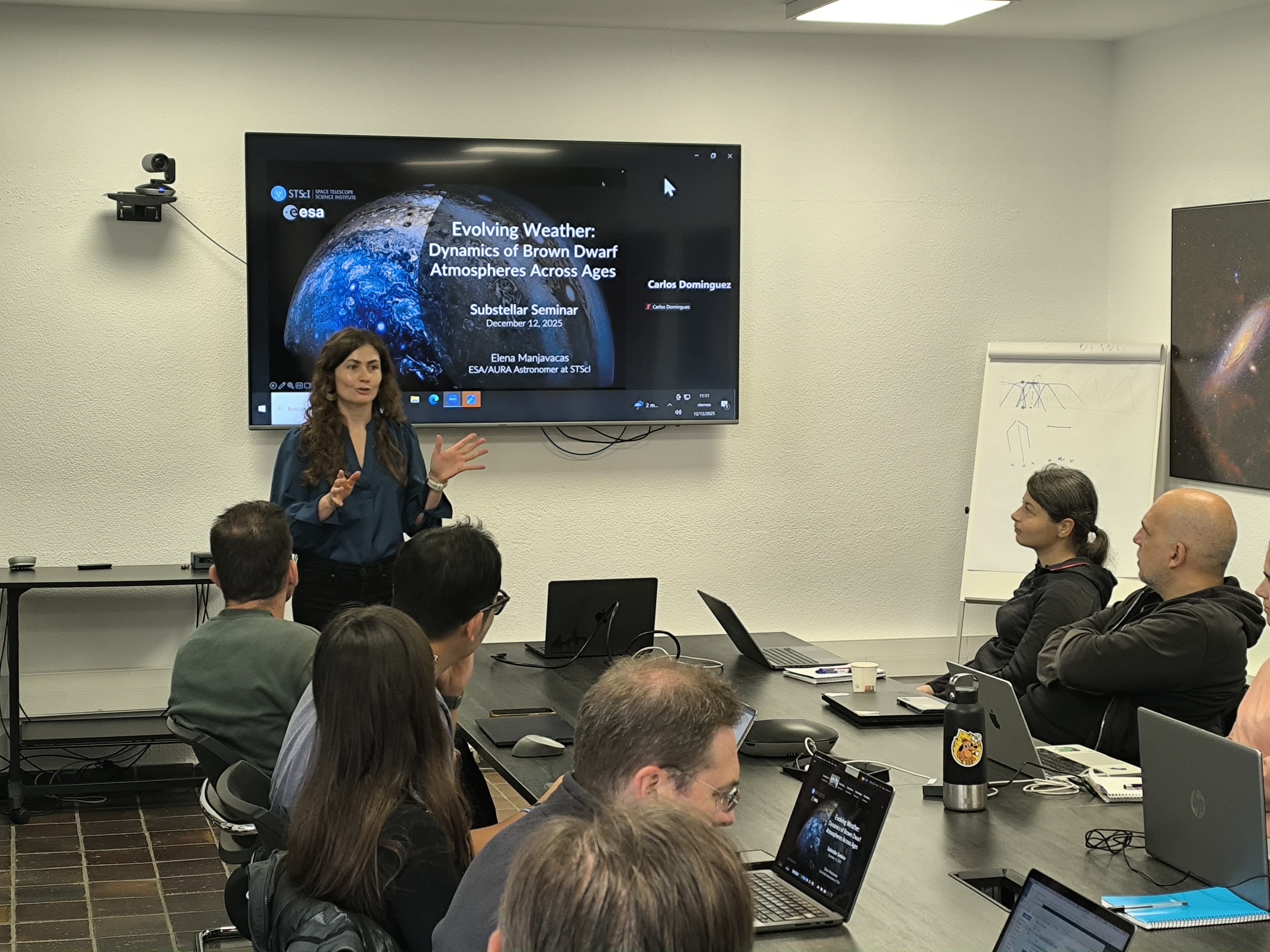 On December 12, 2025, Dr Elena Manjavacas delivered a seminar about her own's team research in the past year.
During the seminar she discussed the potential time-resolved spectroscopy to study the dynamics of brown dwarfs and planetary-mass objects, and why simultaneous near-infrared time-resolved spectroscopy is key to have a holistic understanding of brown dwarf atmospheres. Dr Manjavacas did a review of the discoveries done in the last 15 years using single-band photometry or short wavelength coverage Hubble Space Telescope (HST) time-resolved spectroscopy, and an overall review of the brown dwarf variability characteristics for brown dwarfs of different spectral types. This review is ready to be sent for review to the journal by one of the students of her team (Manjrawaka et al. 2026).
Finally, she discussed the latest discoveries of her group using time-resolved spectroscopy with the NIRSpec and MIRI instruments onboard JWST for two characteristic brown dwarfs, WISE 1049AB (Oliveros-Gomez et al. 2025) and Ross 458c (Bull et al. 2026, in prep, Manjavacas et al. 2026, in prep). For WISE 1049AB, the NIRSpec time-resolved spectroscopy revealed the most likely mechanisms inducing the variability in both binary components. For WISE 1049A, the most likely mechanisms are the existence of heterogenous clouds and thermochemical instabilities, and for WISE 1049B only heterogenous clouds. For Ross 458c, the first results of NIRSpec time-resolved spectra, still under analysis, are revealing that the rotational period measured previously for the object using HST might be a harmonic of the actual rotational period. The cause of the variability for this object is still under investigation.
Dr Elena Manjavacas visited the IAC to collaborate with Prof. Eduardo Martín, SUBSTELLAR principal investigator, and his team.